



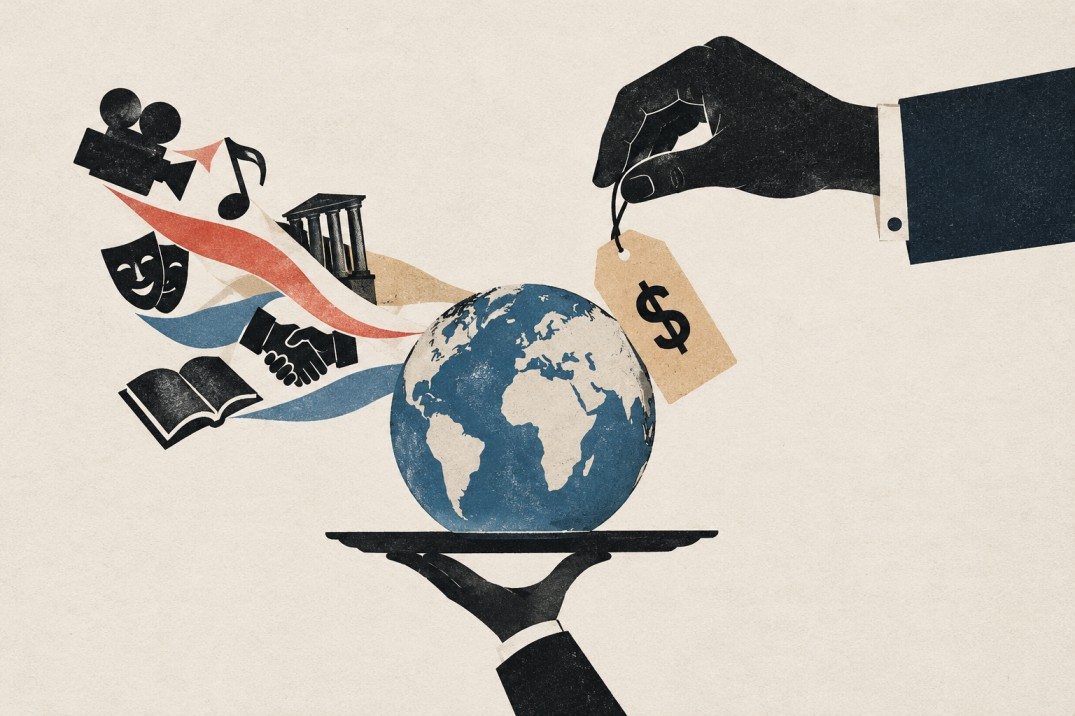
Growing up, I watched films and cartoons and listened to music without ever wondering whether any of it was a form of soft power.
Growing up, I watched films and cartoons and listened to music without ever wondering whether any of it was a form of soft power. It was only at university that I came across the term. At first, I found it rather unsettling. Had I been deliberately influenced all those years without even realising it? The reality, as I would come to understand, was more complicated than that.
Let me tell you something real quick. Never forget that governments can buy advertising, cultural centres and a place on the international stage. However, when it comes to an admiration of the audience or changing behaviour of someone, they cannot buy that. They may spend millions, but can never be that sure they will buy.
In other terms, any government can spend millions making its country visible to the world. I also think that it is the government’s right to do things such as sponsoring festivals, funding scholarships, opening cultural centres and hiring experts and consultants to polish its image and so on. At the end of the day, they may want to put the national story in front of people. But what happens next?
That’s the main question to ask. Do people really become more interested in the country because of a movie, music or kitchen show? Do these activities really change their opinion towards your country?
One of the main problems of soft power policy, governments usually approach soft power as if it is a product. They buy it and that’s it, everyone will love it. No it’s not a product. In the draft logic, it is understandable, but it is also obvious that people are not passive consumers after all. They interpret, question, reject and sometimes embrace messages or narrative because of simple communications message structure.
Here is my take in this notion. A government - it does not matter what type of government you are - can pay to introduce or show its country to the world. However, it cannot dictate the world's response to it.
This is why I mentioned above that there is a huge misconception of soft power as if it is a product to achieve something. Soft power is a relationship. With money, and I mean enough money, you can create opportunities for attraction. Unfortunately, this attraction also depends on what country offers and how audiences interpret it whether they find it credible.
I am going to show you South Korea and China cases as they offer two different ways to examine this problem.
For example, especially for the last 10-15 years, we have been seeing so many successful and really entertaining South Korean musics, movies, etc. as well as its cultural rise in the eyes of people. You may think that the state deliberately invests in these kinds of activities to get more attention and reputation from the world.
You might be true in some cases, but the situation is not what you think it is. In 2016, Jungsoo Kim argued that the Korean Wave did not result in success because of mere government strategy. Yes, there was a state investment but there was also competition in cultural industries, entertainment entrepreneurs, changes in regional markets, digital networks and changes in consumer behaviours all around the world.
A single government investment and policy did not bring success. The situation that brought opportunities to the industry is a way more away from a single government investment. A government policy did not force people to listen to Korean music or dramas. If you create a healthy stage for the industry, entrepreneurs and lift limitations to networks, you will get a high level of creative works that automatically attract people’s attention.
In short, millions of people did not become interested in Korean culture because Seoul instructed them to. They encountered something they enjoyed and chose to return for more.
So on the soft power policy side, I do not say that governments should leave culture alone. Public investment can support artists, develop industries, open markets and facilitate international distribution. However, it cannot guarantee which cultural products will resonate with foreign audiences, let alone ensure that their enthusiasm translates into trust in the Korean government. Governments should understand the limits of what their money accomplishes. Supporting an ecosystem is different from scripting its success.
When it comes to the Chinese case. I want to mention China's Confucius Institutes.
These institutes have partnerships with universities and educational institutions to promote Chinese language and culture. And of course due to connections to the Chinese government, as everyone knows the investment directly comes from the government, it raises concerns about political influence and academic independence.
However, this does not prove that these institutes failed to attract people to Chinese culture. Even if it is invested by the Chinese government, this reason does not justify declaring the entire initiative a failure in soft power policy.
So in this case, we can say that the sponsor can become part of the message, even when the sponsor would prefer the audience to focus on the content.
Even though a language course may offer genuine educational value, yet some people may also see it through the lens of geopolitical competition, asking who funds it, who oversees it and what the sponsor hopes to achieve. It creates an environment that organisers cannot simply wish away. However, we cannot say that government involvement does not turn cultural diplomacy into propaganda or it destroys credibility. On the contrary, when the initiative appears to serve political objectives rather than its core mission, audiences may become more interested in its intentions and have suspicions around it. So the main core of cultural mission fades away in the mind of audiences.
The irony is that a government can invest money opening a door to its culture while giving some people a reason to hesitate before walking through it once its intention differs from the core one.
I think it's enough for cases. Let’s move to a more problematic phase.
Let’s say that after all, governments see statistics with so many numbers, figures to understand reach and participation as well as view counts. So what? Does it mean that the high level of attention can be read as a success? No, not really.
Visibility is not an influence.
Communications are more emotional, not rational. People perceive communications emotionally most of the time. The main question the governments should ask is whether any of those people changed their minds.
I found James Pamment's argument derived from 2014 Public Relations Review that the evaluations of soft power, public diplomacy and nation branding often rely on campaign goals and outputs rather than reliable empirical evidence of results.
This is where I also draw a line. Having a large number of scholarships, participation in language courses, etc. tell us what the project or programme delivered. However, it does not, by itself, tell us whether recipients developed greater trust in the country, maintained lasting relationships with it or became more receptive to its ideas. A country can become popular for its entertainment while its foreign policy remains deeply unpopular.
These outcomes do not make the activity worthless. These simply show why different objectives need different measures. For example, if the goal is tourism, just examine travel decisions, if it is educational engagement, look at the participation. If it is for developing trust, you should measure trust with empirical studies rather than counting media mentions. If the objective is to understand the situation of diplomatic support, investigate whether positions or decisions actually change and consider the many factors besides cultural attraction that may explain them.
This is where the concept of soft power can become misleading. All statistics with reach and view numbers can create opportunities for influence, but it does not prove that influence has occurred.
Being noticed does not mean admiration. Having admiration does not mean being trusted. Having trust does not guarantee political agreement. These are different things to look at.
Soft power has no single outcome called success. Its value depends on what a country hopes to achieve and whether attraction contributes to that objective.
In the end, I am not implying that governments cannot buy soft power or they should stop spending money for it. I mean, friendship cannot be bought so that does not mean that there is no point in inviting anyone to dinner.
Cultural institutions need funding, artists need opportunities, the market needs open gates to resonate the voice, universities need international partnerships and overall governments can support them to make these things possible.
However, investment should be directed towards the conditions that allow attraction to develop, rather than treated as a guarantee that attraction will follow.
Governments need to understand the people they hope to reach, take their interests seriously and accept that audiences will draw different conclusions. They also need to recognise that their conduct matters. A country promoting openness will struggle to make that message credible if its actions consistently suggest otherwise. Most importantly, governments need to measure what matters, not merely what is easiest to count. The number of events held, people reached and programmes funded tells us how much activity took place. Whether that activity produced trust, attraction or a meaningful change in behaviour is a separate question.
All these make strategy more realistic. Governments can influence the conditions under which attraction develops. They cannot own the result. That is the soft power limit. You can buy a platform, fund institutions and carry the country's story across borders, but at the end of the day, even though you spend millions, the other side still gets to decide whether it wants to know more or changes its mind towards you.

Təəssüf ki, kimsə, hansısa qrup və ya hansısa ölkə sizə qarşı sistemli informasiya müharibəsi aparır

Beynəlxalq mediada yazılan xəbərləri oxumaq da özü-özlüyündə diqqət edilməsi məsələdir.
Həmişə deyilən bir söz var. Fakt öz özlüyündə qalır.
